Platform and implementation for managing general agents
MGA Insurance Software
One system for the business a carrier delegates to you.
Nexora is MGA insurance software built for delegated authority. A submission arrives from a broker, the rules that a carrier wrote into the binder decide what can be quoted without a human, and the policy, the documents and the carrier bordereaux come out of the same record. Nothing is rekeyed between those steps.
It was built for a European specialty broker and MGA writing professional indemnity, cyber insurance, commercial property and general liability across the European Economic Area, and it is now available to other MGAs, MGUs and coverholders with the same problem.
- Built for
- MGAs, MGUs and coverholders writing delegated business in the European Economic Area
- Covers
- Submission intake, underwriting, policy administration, premium and commission, bordereaux, claims intake
- Model
- Platform plus implementation. No self-service signup, no pricing page until the commercial model is settled.
- Origin
- Built by Pharos Production for a European specialty broker and MGA, in production since the first year of the program
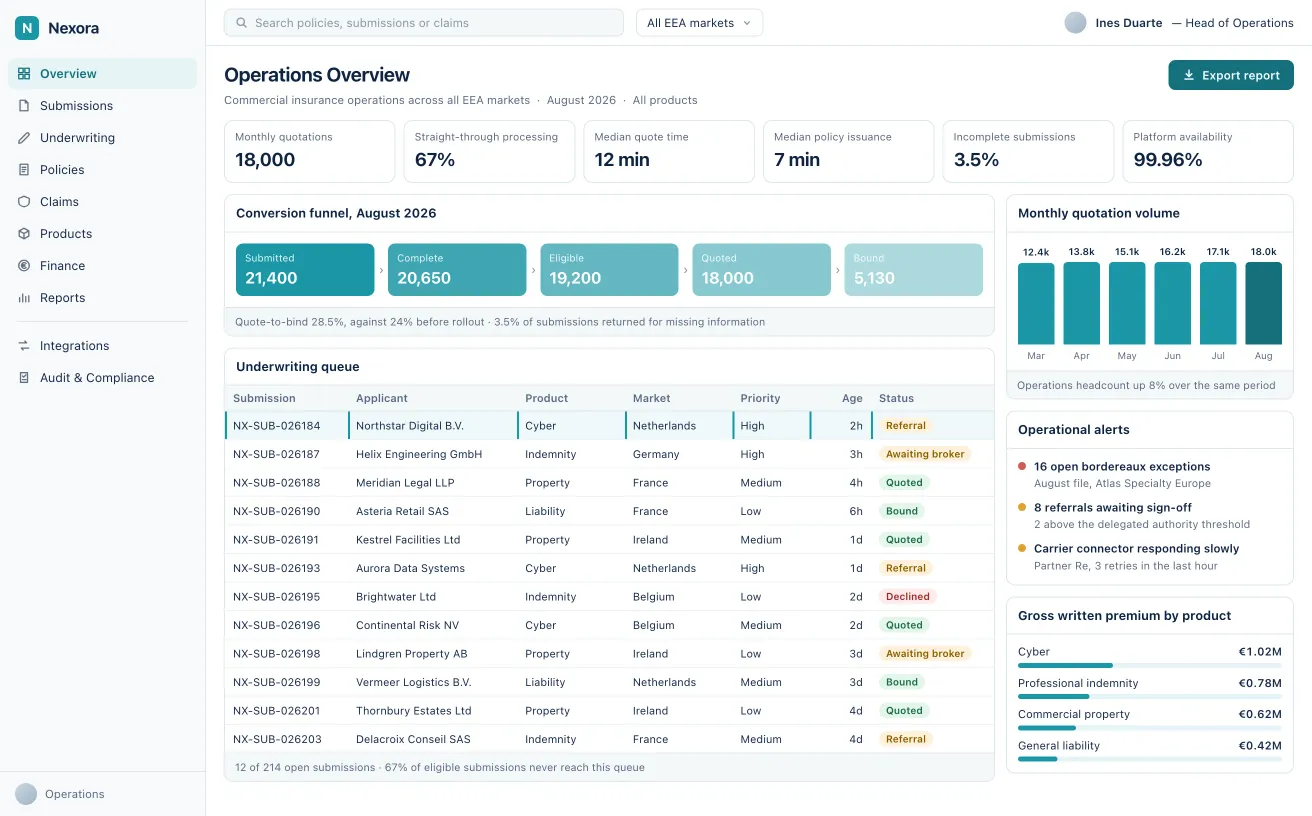
67%
of new business quoted straight through, from a manual baseline
12 minutes
median quotation cycle, down from 45 minutes
18,000
quotations a month within the first year, on 8% operations headcount growth
These are measured results of one implementation for a European specialty broker and MGA, over the first twelve months in production. They describe that book of business rather than a promise the platform makes to the next one. Read the implementation case study.
What software for managing general agents has to carry
An MGA sits between a broker and a carrier, holds someone else's pen and has to prove how every risk was written. That is a different job from the one a carrier policy admin system was designed for.
An MGA platform has to hold two authorities at once. A carrier delegates underwriting inside a binder, with limits, exclusions and referral triggers that are contractual rather than advisory. The broker expects a quote today. Insurance software for MGAs earns its place when it can satisfy both without an underwriter retyping a submission into a rating spreadsheet.
The second job is evidence. A capacity provider that delegates binding authority audits how it was used, and the answer has to survive a Solvency II data lineage question about where a number came from. That is why every record in Nexora is versioned rather than overwritten, and why a bordereaux line can be traced back to the transaction that produced it.
Delegated authority, encoded
Binder limits, eligibility rules and referral thresholds live in the platform as rules an underwriter can read, not as tribal knowledge in a spreadsheet.
One record, many outputs
The quote, the policy schedule, the invoice, the carrier report and the audit trail are views of the same data, so they cannot drift apart.
Maker-checker where it counts
Overrides, cancellations and rate changes carry an approver and a reason, and neither can be removed after the fact.
Multi-market by construction
Products, documents and correspondence exist per market and per language rather than as translations bolted on at the end.
The delegated authority lifecycle, end to end
Six things an MGA does every day. In most shops they live in five systems and a shared drive.
Submission intake
A broker portal that validates while the submission is being filled in, so an incomplete risk is caught at the broker's desk instead of three emails later.
Underwriting and referral
Deterministic eligibility rules and risk scoring decide what is quoted automatically and what goes to a senior underwriter, with the reason shown. More on the underwriting workbench.
Policy administration
Effective-dated versions, endorsements, renewals and cancellations against an immutable history, with documents generated in the policyholder's language.
Premium and commission
Premium collection, commission splits between the MGA, the introducing broker and the carrier, and the accounting entries that follow from them.
Bordereaux and carrier reporting
Premium and claims bordereaux in each carrier's own format, reconciled against the policy records they came from. More on bordereaux management.
Claims intake and triage
First notice of loss, coverage checks against the policy as it stood on the date of loss, reserving and handover to a TPA where one is appointed.
Where the platform ends and the engineering starts
The platform is the product. Getting it live inside an MGA that already has a book of business is the other half of the work, and it is not a download.
01
Discovery against the binders
We read the binders, not the brochure. Limits, referral triggers and reporting obligations differ per carrier, and they decide what the rules engine has to express.
02
Data migration
Active policies, historical policies and documents move with their version history intact, because an audit asks about a policy as it stood four years ago.
03
Carrier and TPA integration
Each capacity provider has its own file formats, portals and timetables. Those integrations are built, tested against the carrier's own validation and then monitored.
04
Cutover and support
A parallel run, a dated cutover and an engineering team that stays reachable afterwards. The people who answer are the people who wrote the code.
Built for European delegated authority, not adapted to it
Every market that delegates underwriting has its own vocabulary, its own reporting standard and its own regulator. A platform that treats them as translations of an English original gets the vocabulary right and the obligations wrong.
Distribution obligations under the IDD sit inside the quote flow rather than in a compliance appendix. That covers the demands and needs record as well as precontractual disclosure. Personal data handling follows the GDPR, with retention rules that a data protection officer can inspect. Operational resilience follows DORA, and the recovery objectives are contractual numbers rather than aspirations.
The regional editions of this site are written for their own markets, because the concepts do not map. Germany runs on BiPRO norms and reports to BaFin. The Netherlands runs on SIVI standards under the Wft. France works with quittancement and reports to the ACPR.
Deutschland
Software für Assekuradeure, mit BiPRO-Schnittstellen und Bestandsführung.
Nederland
Software voor gevolmachtigd agenten, met SIVI AFS en polisadministratie.
France
Logiciel pour courtier grossiste, avec quittancement et délégation de gestion.
Nexora is a platform, not an insurer and not a broker. It does not carry risk, does not hold client money and does not advise on cover.
Who stands behind Nexora

Nexora is founder run. The person who decides what gets built is the person who answers the email about it, and there is no sales layer in between.
Alex Klein founded Nexora on one conviction. An MGA does not need a carrier system with the underwriting authority filed off, it needs a system that treats a delegated authority as the contract it actually is. That conviction decides what goes into the platform and, more often, what stays out of it. No pricing page while the commercial model is unsettled, no self-service signup for a product that needs a binder read before it can be configured.
Working from Berlin puts him inside the market this platform is built for rather than across an ocean from it. German, Dutch and French delegated authority each run on their own standards and their own regulator, which is why the regional editions of this site exist as separate cores instead of translations.
The engineering is delivered with Pharos Production, the firm that built the platform and ran the fourteen-month implementation program behind it. That split is deliberate. Product decisions sit with the founder, and the engineers who wrote the code stay reachable for the questions that need them.
Questions buyers ask
What is MGA insurance software?
It is the system a managing general agent runs its delegated business on. Broker submission intake, underwriting inside the authority a carrier granted, policy issuance and administration, premium and commission accounting, bordereaux reporting back to that carrier, and claims intake. What separates it from general insurance software is that the underwriting authority belongs to someone else, so the system has to enforce a binder and evidence how it was used.
What does an MGA platform need to do that a carrier system does not?
Three things. It has to enforce delegated authority limits a carrier set contractually, including referral triggers and override approvals. It has to produce carrier bordereaux in whatever format each capacity provider demands, on that carrier's timetable. And it has to work for several carriers at once, since an MGA usually places different products with different capacity, each under its own binder.
How is this different from a carrier policy administration system?
A carrier system assumes the underwriting authority is yours. An MGA system assumes it was lent to you and can be withdrawn. That changes the data model. Every decision carries the rule that allowed it, every override carries an approver, and the reporting runs outward to the capacity provider rather than inward to a group reporting function. Retrofitting that onto a carrier platform is usually more expensive than it looks.
Can one platform cover underwriting, policy administration and claims?
Yes, and the reason to want it is not tidiness. When claims sit in a separate system, a first notice of loss has to be matched back to the policy as it stood on the date of loss, which is where mismatches appear. On one record the coverage check reads the policy version directly, and the claim, the reserve and the bordereaux line stay consistent with each other.
How long does an MGA platform rollout take?
The reference implementation ran fourteen months from discovery to full production, including migration of the historical book and integration with six carrier systems. A smaller MGA with one carrier and no legacy history is a much shorter engagement. The variables that move the number are the count of capacity providers, the state of the data being migrated and how much of the binder is written down.
Talk to the engineers who built it
If you run delegated authority and your quarter ends in spreadsheets, tell us what your carriers ask for and we will tell you what implementation would look like.
Write to us about the platform
No pricing page yet, deliberately. Every MGA implementation is scoped against its binders, so a number on a page would be fiction.