Automation with an underwriter still in charge
Underwriting Workbench Software
Standard risks should not wait for a person to read them.
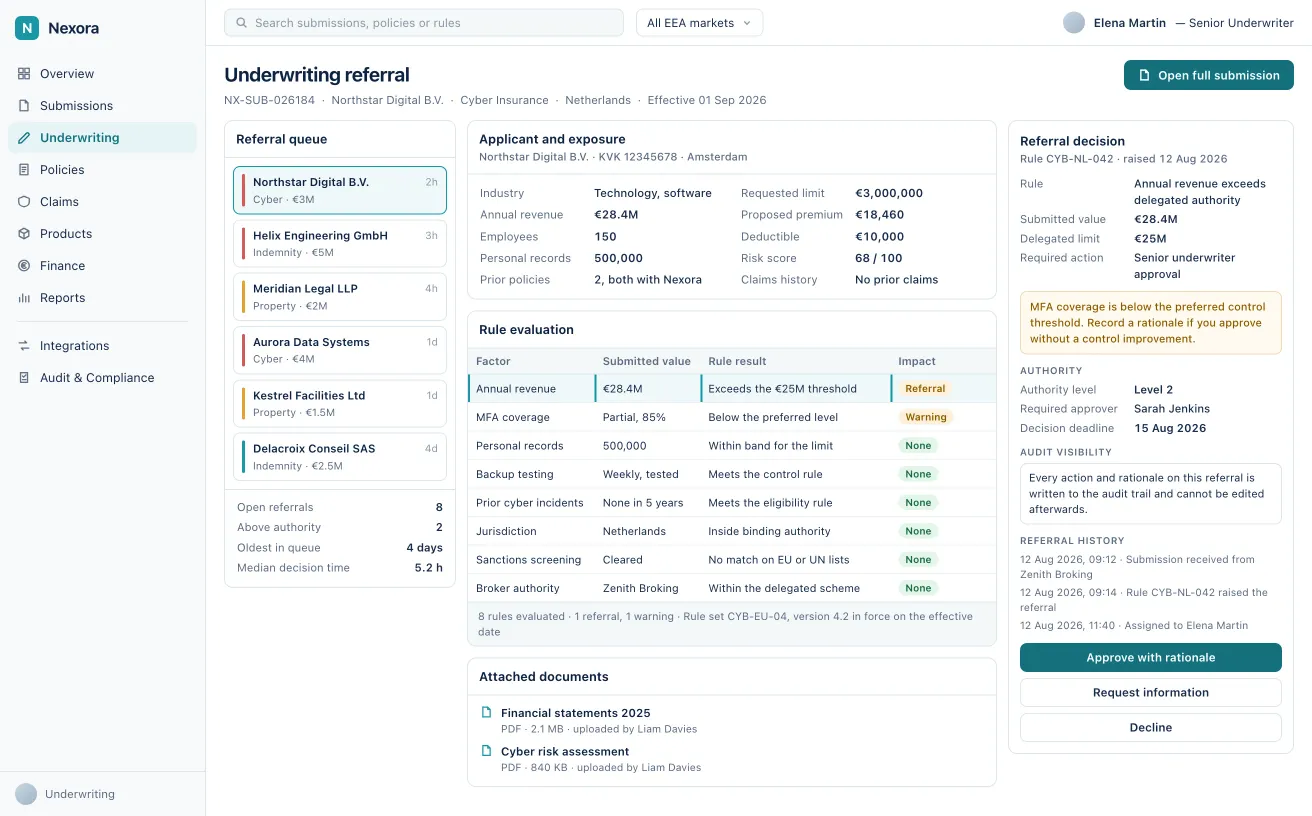
Underwriting workbench software decides, in the moment a submission lands, whether a risk can be quoted inside the authority a carrier delegated. Eligibility rules and risk scoring run first. What clears them is quoted and can be bound. What breaches a threshold becomes a referral, with the rule that fired and the value that tripped it shown to the underwriter who picks it up.
The purpose is not to underwrite without underwriters. It is to stop spending underwriting time on the risks that were never in question, so the hours go to the ones that are.
- Decides with
- Eligibility rules, rating tables and deterministic risk scoring, evaluated in a fixed order
- Escalates through
- Referral queues with the failing rule, the threshold and the submitted value shown
- Controls
- Override authority per user, senior underwriter sign-off on anything outside the binder, and a reason recorded on every exception
67%
of new business underwritten straight through, from a fully manual starting point
12 minutes
median quotation cycle, down from 45 minutes
7 minutes
median time to issue a policy once terms are accepted
From one implementation for a European specialty broker and MGA, measured over the first year in production against its own prior baseline. The rate any given book reaches depends on how much of its underwriting guidance is written down. Read the implementation case study.
What an underwriting workbench is
A workbench is the underwriter's desktop. One screen holding the submission, the risk data, the rules that apply to it and the actions available, instead of a mail thread, a rating spreadsheet and a policy system in three windows.
Automated underwriting software is often sold as a black box that returns a decision. That is the wrong shape for delegated authority, because a coverholder has to be able to show a carrier how the binding authority it was granted was used. Nexora evaluates rules deterministically and keeps the evaluation. The same submission always produces the same decision, and the decision carries its own explanation.
Rules come from the binder and from underwriting guidelines, expressed as conditions an underwriter can read. Class of business, sums insured, territory, claims history, prior policy record and the presence of a required warranty are all inputs. So is a risk score, when the book supports one.
Eligibility rules
Hard boundaries from the binder. A risk outside them cannot be bound, no matter who is logged in.
Rating tables
Effective-dated, versioned and testable. Yesterday's quote can be reproduced with yesterday's table.
Risk scoring
Deterministic and inspectable. A score is a number with an arithmetic behind it that an underwriter can check.
Referral triggers
Thresholds that send a risk to a human, with the reason attached rather than a bare flag.
Straight-through processing, and what it should not swallow
Straight-through processing means a submission is quoted, accepted and issued without a person touching it. The interesting question is which risks belong in that path.
Moving from no automated underwriting at all to 67% of new business quoted straight through was the shift in the reference implementation. What stayed manual was not a failure. This is a specialty book, and the risks that referred were the ones carrying accumulation, unusual territory or a claims history that deserved reading.
A useful STP target is set per product rather than for the whole book. A small commercial property risk with a clean history is a different proposition from a professional indemnity risk for a firm that has just changed its activities, and a platform that treats them the same is either too permissive or too slow.
Automated decisions here sit inside a delegated authority. They do not remove the MGA's obligations under its binder, and they do not constitute advice to the policyholder.
Overrides, and who is allowed to make them
Every underwriting system eventually meets a risk somebody wants to write anyway. The control is not preventing that. It is recording it.
Override authority is granted per user and per rule class. An underwriter can relax a soft guideline within a documented band. Anything that touches a binder limit requires senior underwriter sign-off, and the approval is stored with the reason, the approver and the timestamp on the policy record itself.
That record is what turns a carrier audit from an exercise in reconstruction into a query. It is also what the bordereaux reporting draws on, since a carrier reviewing delegated business will compare what was written against what the binder allowed. See how the reporting side works.
Getting rules out of people's heads
The hardest part of underwriting automation is not the engine. It is that half the guidance exists as a shared understanding among three underwriters.
01
Extract the rules
Sessions with the underwriting team against real declined and referred submissions. What comes out is a list of conditions, and usually a few disagreements worth resolving.
02
Encode and test
Rules are implemented and replayed against historical submissions, so the team can see which past decisions the configuration would have changed before anything is live.
03
Start conservative
The first configuration refers more than it needs to. Thresholds loosen once the referral queue shows which referrals were never contentious.
04
Keep measuring
Straight-through rate, referral reasons and override frequency are reported per product, because a rising override count on one rule usually means the rule is wrong.
Who stands behind Nexora

An underwriting engine that cannot explain itself is worse than no engine at all, so it is worth knowing who ruled out the alternative.
Alex Klein founded Nexora, and the rules in this platform are deterministic because he decided they would be. A model that scores a risk and cannot say why is a poor fit for delegated authority, where the authority is a contract and every decision may have to be defended to the carrier that granted it. So the platform keeps the evaluation, not just the outcome, and a referral from last quarter can still be explained today.
He runs the company from Berlin and holds the product line against the standing pressure to automate further than the binder allows. The engineering is delivered with Pharos Production, the firm that built the platform, which is who answers when the question is how a rule is evaluated rather than why it exists.
Questions buyers ask
What is an underwriting workbench?
It is the working environment an underwriter operates in. It holds the submission, the risk data, the rules and rating that apply, the referral history and the actions available, in one place. The distinction against a policy administration system is one of purpose: the workbench supports the decision, the policy system records what was decided.
What is straight-through processing in insurance?
Straight-through processing, or STP, is the share of business that goes from submission to quote and issuance with no manual intervention. It is usually reported as a percentage of new business. The figure only means something alongside the product mix, since a homogeneous personal lines book and a specialty commercial book are not comparable.
What share of submissions can be underwritten automatically?
For a specialty commercial book, somewhere between half and three quarters is a realistic target once the rules are written down, and the reference implementation reached 67% in its first year. The limiting factor is rarely the technology. It is how much of the underwriting guidance exists in a form that can be stated as a condition.
How are underwriting overrides controlled?
Through authority levels rather than trust. Each user carries an override authority, soft guidelines can be relaxed within a band, and anything touching a binder limit needs senior underwriter sign-off. Every override stores its reason, its approver and its timestamp against the policy, which is what a carrier audit asks to see.
How does a workbench show why a risk was referred?
By keeping the evaluation rather than only its outcome. The underwriter sees each rule that ran, the threshold it applied, the submitted value and which check failed. That matters twice: the underwriter picking up the referral does not have to reconstruct it, and the same view is what evidences the decision months later.
Bring your referral queue
If most of what reaches your underwriters would have been quoted anyway, the ratio is fixable. Tell us what your current referral reasons look like.
Write to us about underwriting
A useful first conversation is about your declined and referred submissions from one quarter, not about our feature list.