Carrier reporting for delegated authority
Bordereaux Management Software
The month-end report your carrier will actually accept.
Bordereaux management software turns the month you delegated into the file your carrier asked for. Premium bordereaux and claims bordereaux are built from policy records rather than assembled in a spreadsheet, mapped into each capacity provider's own format, and reconciled line by line before anyone sends anything.
The part that costs an MGA its evenings is not producing the file. It is the reconciliation afterwards, when a carrier's cash does not agree with the schedule and somebody has to find out which endorsement moved.
- Produces
- Premium bordereaux, claims bordereaux and the reconciliation behind both
- Per carrier
- Column layouts, code lists, currencies and submission timetables differ per capacity provider and are configured per binder
- Evidence
- Every line traces back to the transaction that produced it, so a query about a number has an answer rather than an investigation
About 4 hours
monthly carrier bordereaux cycle, down from 5 to 7 business days
58%
less manual data entry and reconciliation effort
Six
carrier systems integrated, each with its own format and timetable
Measured on one implementation for a European specialty broker and MGA reporting to six capacity providers. The numbers describe that reporting cycle rather than a result the software guarantees elsewhere. Read the implementation case study.
What a bordereau is, and why it is harder than it sounds
A bordereau is the schedule a coverholder sends its carrier listing what was written or paid under delegated authority. A premium bordereau reports the business bound. A claims bordereau reports what was notified, reserved and paid.
On paper this is a report. In practice it is an accounting reconciliation between two organizations that keep their books differently. The carrier posts cash when it receives it. The MGA posts premium when the risk incepts. Mid-term adjustments, cancellations, refunds and commission clawbacks land in different periods on the two sides, and the difference has to be explainable rather than merely small.
This is why bordereaux built in a spreadsheet degrade over time. The formulas encode last year's binder, the column order encodes what the carrier wanted before its own migration, and nobody notices until a submission is rejected on the day it was due.
Built from records
Each line is generated from the policy version that was in force, not typed from a report that was already a copy.
Mapped per carrier
Column order, code lists, currency handling and file format are configured per binder, so one book of business produces several correct files.
Validated before sending
The same checks the carrier runs on receipt run here first, which is the difference between a rejection and an amendment.
Automated premium reconciliation, and the exceptions it leaves behind
Matching is the easy half. The value is in what the software does with the lines that do not match.
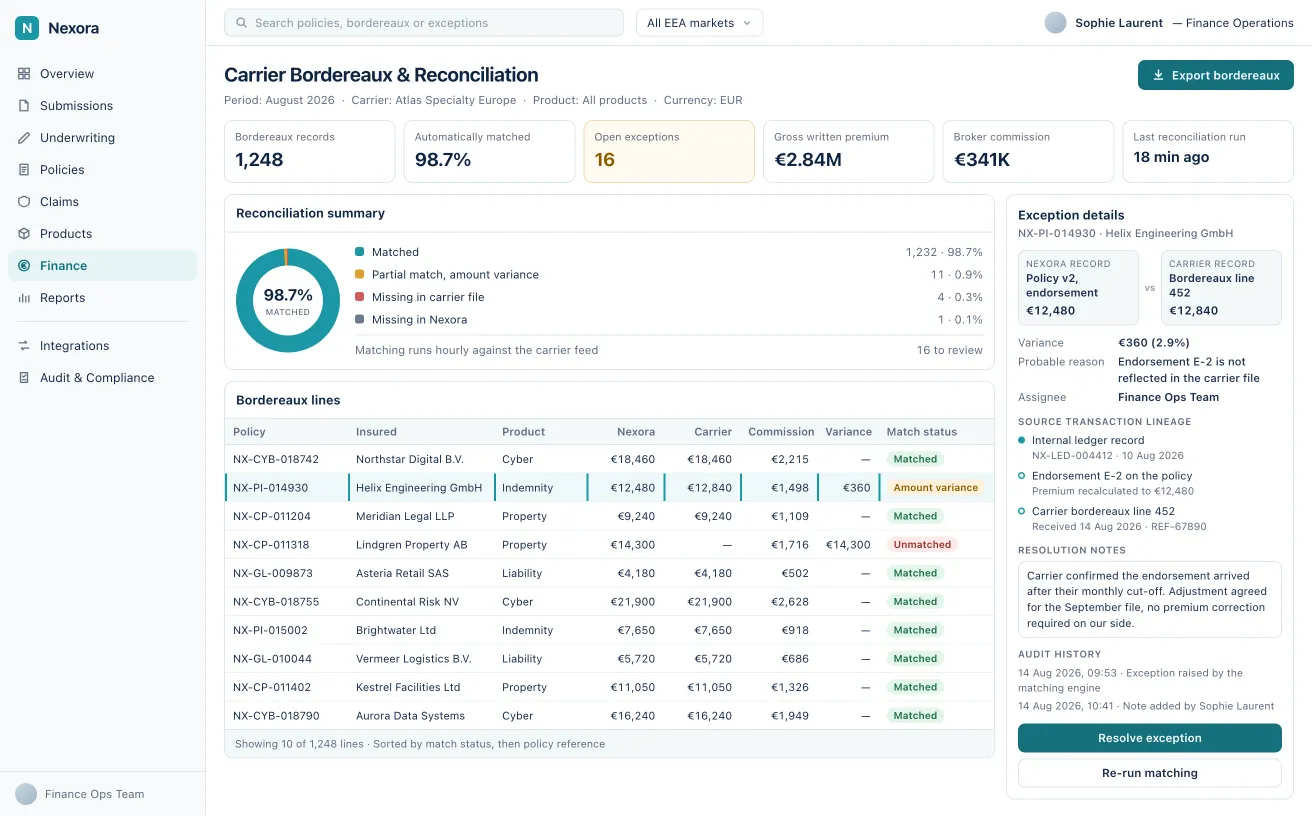
Every incoming carrier statement is matched against the bordereaux lines that produced it. Amounts that agree are closed automatically. Amounts that do not are grouped into exceptions with the transaction history attached, so the question in front of a finance team is a specific one about a specific policy rather than a general one about a total.
Source transaction lineage means each figure can be walked backwards. A premium line resolves to the endorsement that changed it, to the underwriter who approved it and to the date it took effect. That trail is what makes a Solvency II data lineage question answerable, and it is the same trail an internal audit asks for.
The reconciliation is a reporting and accounting function. It does not move money, and it does not replace the client money controls an MGA operates under its own regulatory permissions.
Where premium accounting lands afterwards
A bordereau that reconciles is only useful if the ledger agrees with it.
Commission splits between the MGA, the introducing broker and the capacity provider are calculated from the same policy record the bordereau was built from, so the commission statement and the carrier report cannot disagree. In the reference implementation the resulting entries post into Microsoft Dynamics 365 Business Central, and collection runs through Adyen for card and direct debit payments. Both are integrations rather than requirements, since the accounting boundary is defined per client.
Claims bordereaux follow the same route. Reserve movements and payments are reported from the claim record, which is linked to the policy version that was in force on the date of loss, so coverage disputes have a documented basis.
What implementation looks like
Most of the work is in the binders and in the history, not in the reporting engine.
01
Read every binder
Reporting obligations, formats and deadlines are contractual. They come out of the binders and go into configuration, one capacity provider at a time.
02
Rebuild the last closed period
The first deliverable is the previous month, produced by the platform and compared against what was actually sent. Differences are findings, and they are worth having early.
03
Run in parallel
One or two cycles are produced both ways. The MGA keeps its old process until the carrier accepts the new file without comment.
04
Hand over the exceptions
Once live, the daily work is the exception queue rather than the report. That is the point at which finance teams stop planning their month around a deadline. See the rest of the platform.
Who stands behind Nexora

Bordereaux logic is where a platform earns trust or loses it, so it is worth knowing who set the rule that every figure has to be traceable rather than merely correct.
Alex Klein founded Nexora, and the reconciliation model follows from the product decision he made at the start. Every policy record is versioned rather than overwritten, which costs storage and makes changes slower to ship. It is also the only reason a bordereaux line can be walked back to the endorsement that produced it, and the reason exception handling is a queue rather than an investigation.
He runs the company from Berlin, close enough to the German, Dutch and French markets that carrier reporting differences are a working constraint rather than a footnote. The engineering is delivered with Pharos Production, the firm that built the platform, so a question about how a match is computed reaches the people who wrote that code.
Questions buyers ask
What is a bordereau in insurance?
A bordereau is a periodic schedule a coverholder or MGA sends to the carrier that delegated underwriting authority to it. It lists the business written or the claims activity for a period, usually monthly. The carrier uses it to book premium, monitor its delegated portfolio and check that the business written stayed inside the binder.
What is the difference between premium and claims bordereaux?
A premium bordereau reports the risks bound in the period, with sums insured, premium, taxes and commission. A claims bordereau reports claims activity, so notifications, reserve movements, payments and recoveries. They are usually produced on the same cycle and reconciled separately, because premium reconciles against cash received and claims reconcile against funds paid out or held.
How often are bordereaux submitted to carriers?
Monthly is the common cadence, with a submission deadline in the first or second week after period end. Some binders require quarterly reporting, and some large capacity providers ask for weekly claims reporting on volatile classes. The deadline is contractual, which is why a manual process that takes most of a week leaves no room when a person is on leave.
Why do bordereaux fail carrier validation?
Usually for structural reasons rather than wrong numbers. A code that is not on the carrier's current list, a column that moved, a currency reported at the wrong precision, a canceled policy still present, or a mid-term adjustment reported in a period the carrier already closed. Running the carrier's own validation before submission removes almost all of these.
Can bordereaux be reconciled automatically?
Matching can be, and in the reference implementation most of it is. What needs a person is the exceptions, and there will always be some, because timing differences between two sets of books are legitimate. Zero exceptions is the wrong target. Aim instead for each exception arriving with its transaction history attached, so it takes minutes rather than an afternoon.
Send us a bordereau and a binder
The fastest way to scope this is with a real file. Tell us how many capacity providers you report to and what your current cycle costs you in days.
We do not need production data to start. A redacted file and the reporting clauses from one binder are enough for a first assessment.